





.svg)









 Traci Ruether
28 minutes read
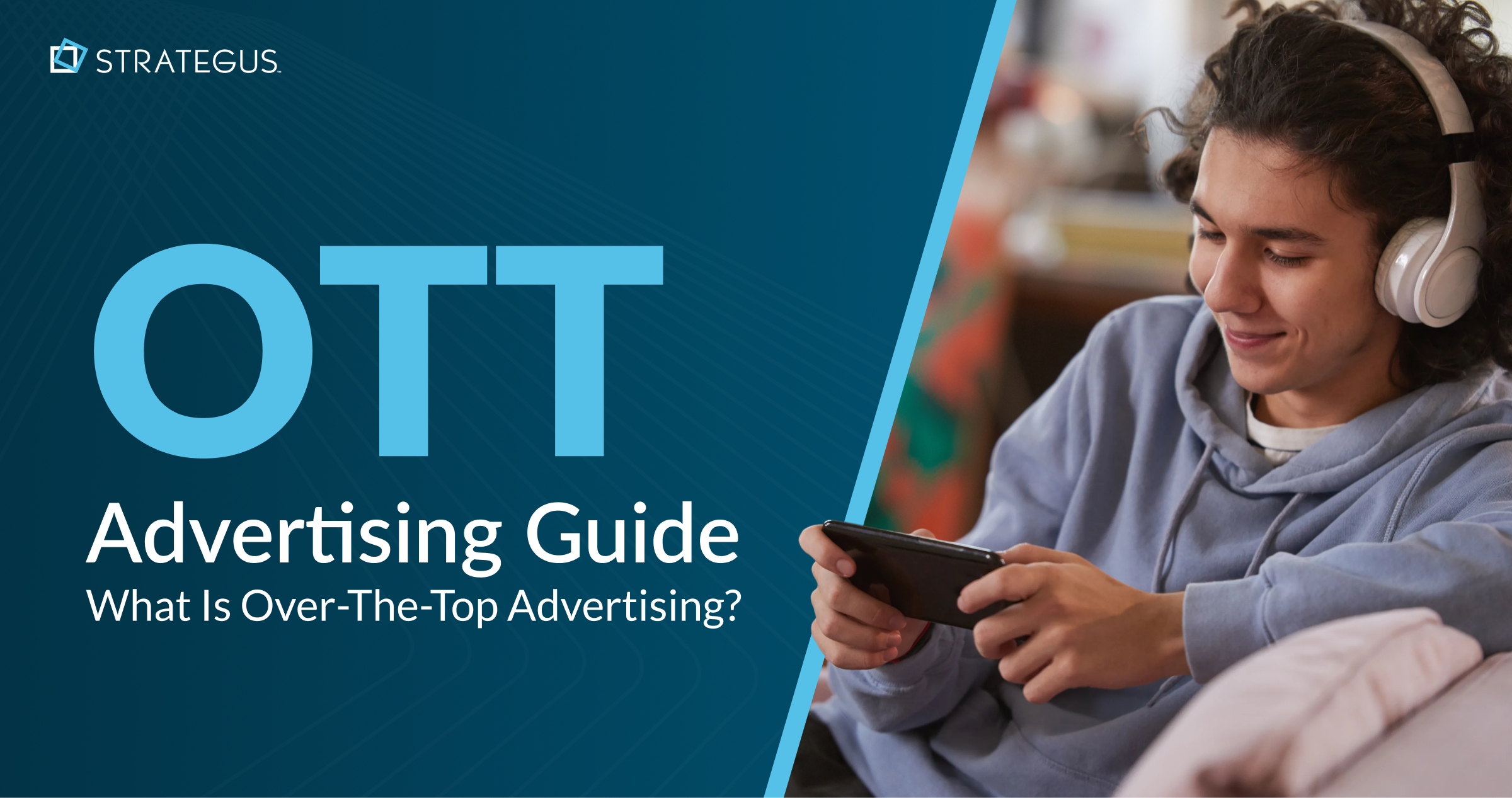
OTT advertising sits across dozens of platforms with a targeting and measurement infrastructure that works differently from every other digital channel. Advertisers who treat it like a simple alternative to linear TV tend to overpay and underperform.
This guide covers how OTT advertising works, the formats and platforms available, what it costs, and how to structure campaigns that get results.
What is OTT Advertising?
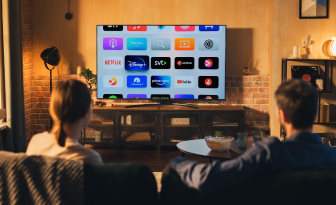
OTT advertising is the delivery of video ads through streaming platforms like Netflix, Hulu, or Roku, bypassing traditional cable TV.
It lets brands show ads to viewers watching content over the internet on connected TVs, phones, or tablets. These ads are often targeted by behavior, location, or interests, making them more efficient than regular TV ads.
It can be thought of as a next-generation format of traditional TV advertising.
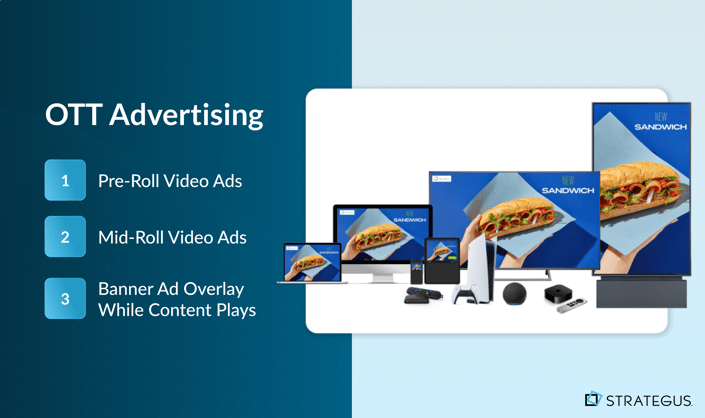
These can take a few different forms:
- Pre-roll video ads that play before the content starts.
- Mid-roll video ads that pop up in the middle of viewing.
- Banner ads that appear as a static graphic overlay on the content.
Most streaming platforms have adopted OTT advertising as a part of their monetization strategy today. Hybrid video-on-demand (HVOD) services like Amazon Prime offer ad-supported tiers with lower monthly fees, whereas free ad-supported streaming TV (FAST) services like Tubi rely entirely on advertising to generate revenue.
OTT ads can be understood as streaming TV ads. And because these are often placed programmatically, they offer several advantages over traditional TV advertising.
Let’s take a look at a few more acronyms that pop up when discussing streaming TV ads:
OTT vs. CTV advertising
You’ve probably streamed content on a laptop or phone before. That’s OTT. OTT ads run on any internet-connected device, including smartphones, tablets, desktops, and more.
CTV advertising, on the other hand, is limited to streaming on connected big-screen TVs like Roku, Fire TV, or smart TVs. This makes CTV a premium subset of OTT. Still, many people use “OTT” and “CTV” interchangeably.
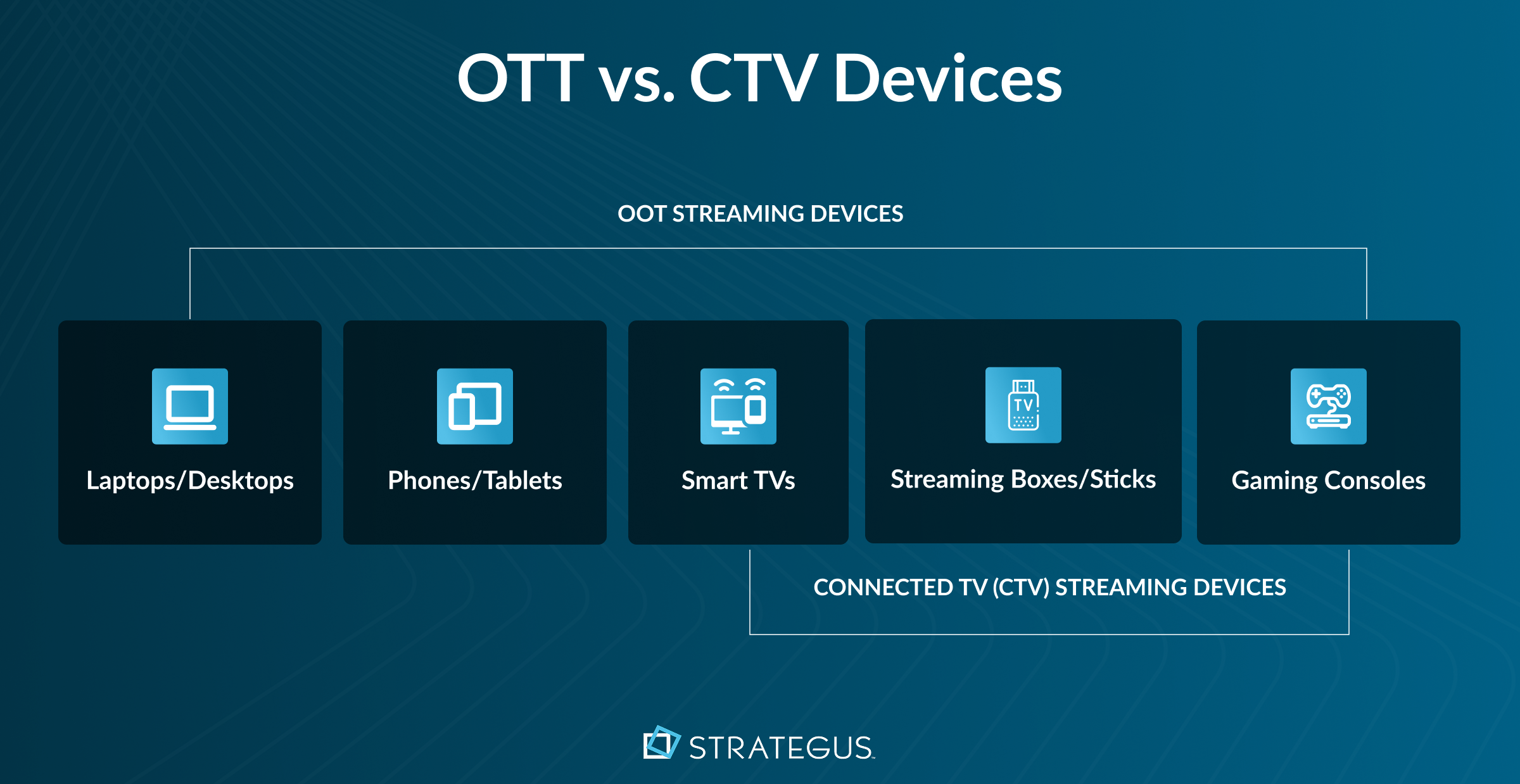
The important distinction between the two is:
- OTT refers to the delivery method (streaming video over the internet).
- CTV refers to the devices used to access OTT content (smart TVs, streaming devices, etc.).
OTT vs. VoD advertising
OTT and VOD are often used interchangeably, but they mean different things.
OTT is the delivery method—video content streamed over the internet across devices like phones, tablets, and smart TVs. VOD, or video on demand, refers to the viewing experience where users choose what to watch and when, rather than following a set schedule.
Most VOD content today is delivered via OTT platforms, but not all OTT content is on-demand.
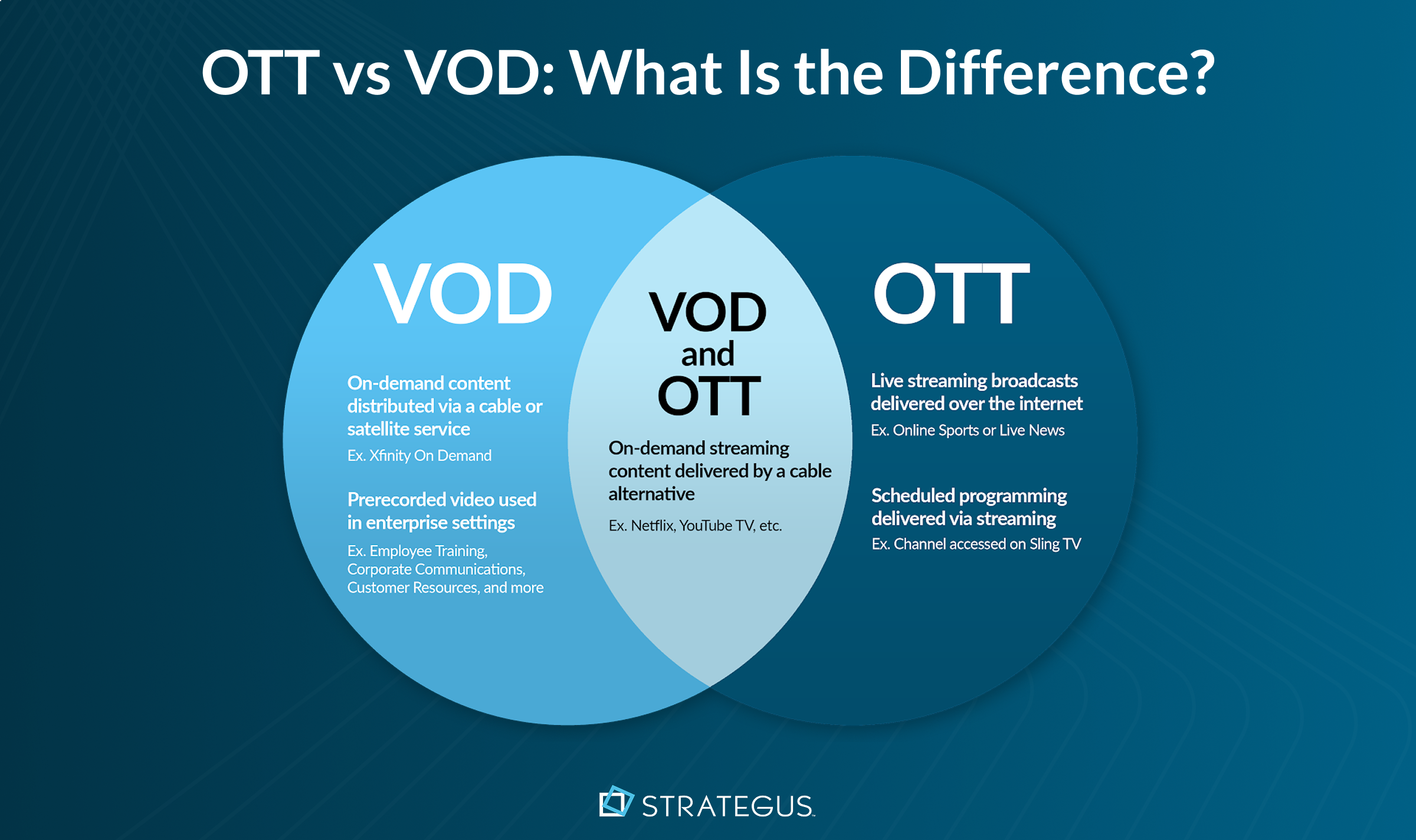
The primary reason that these two are different is that all linear and live content, such as live sports streaming and scheduled TV channels on Hulu+ LiveTV or Tubi, falls outside of the world of VOD.
PVOD (premium video on demand) sits within the broader VOD category as a higher-priced tier, typically used for new-release movies available to rent or buy digitally before or during their theatrical window.
Why? This type of content will play whether the user initiates it or not, and is never “on demand.”
How Does OTT Advertising Work?
OTT advertising operates on a fundamentally different level than traditional TV commercials. While your old cable ads played to whoever happened to be watching, OTT serves specific ads to specific households based on actual viewing data and digital footprints. It's precision targeting meets premium content, a combination that's changing how brands think about video advertising.
The technical infrastructure behind OTT is what makes this precision possible. Every streaming session generates data points that advertisers can use: what device you're using, your viewing history, even your shopping behavior if you're logged into a retail app.
This data flows through a complex ecosystem of platforms and exchanges in milliseconds, determining which ad you'll see next.
Here's how the entire OTT advertising process works from campaign setup to delivery:
- Platform Selection & Integration: Choose between publisher direct deals (Hulu, Paramount+) or programmatic platforms for broader reach. Set up campaign parameters including budget, flight dates, and KPIs. Integrate measurement partners for attribution and brand lift studies.
- Audience Building & Targeting: Upload first-party CRM data for custom audience matching. Layer demographic, behavioral, and contextual targeting parameters. Create lookalike audiences based on your best customers' profiles.
- Real-Time Bidding Process: The streaming platform detects an ad opportunity and sends bid requests with anonymized viewer data. Your DSP evaluates the opportunity against campaign criteria in under 100 milliseconds. Winning bids trigger immediate ad delivery to the viewer's device.
- Dynamic Ad Insertion: Server-side ad insertion (SSAI) stitches ads directly into the content stream. Client-side insertion delivers ads from the viewer's device for more targeting flexibility. Ads are formatted automatically for each screen size and resolution.
- Performance Optimization: Track completion rates, brand lift, and cross-device conversions in real-time. Adjust targeting and creative based on performance data.
OTT Ad Formats
OTT has evolved far beyond the standard pre-roll (ads shown before the content starts playing). Today’s streaming environments support a range of formats suited to different goals and placements:
In-video ads
In-video or in-stream ads play before (pre-roll), during (mid-roll), or after (post-roll) the content itself, in the same viewing environment that the viewer watches their movie or show.
Ads can be skippable or non-skippable, depending on the platform. Naturally, non-skippable ads have higher completion rates, but skippable ads tend to perform better with high-intent audiences (if they don’t skip, it's likely they are interested in what the ad has to show).
Banner ads
Banner ads are displayed above, below, or to the side of the window through which the content is streamed in. They’re non-intrusive, as the video being streamed continues playing while the ad is displayed.
Banner ads can be a good option for building frequency on AVOD platforms without introducing interruptive ad fatigue.
Overlay ads
Overlay ads appear on top of the content being streamed, during playback.
They’re semi-transparent or smaller than the content itself and are often clickable, making them a useful tool for keeping a CTA on-screen after a pre-roll or mid-roll ad without fully interrupting the viewing experience.
Companion ads
Companion ads are similar in concept to overlay ads, but they run alongside the video in a side panel or in a lower-third. They can be used to extend exposure without interrupting content streaming.
Interactive and shoppable ads
Interactive and shoppable ads can include product carousels, QR codes, or add-to-cart overlays, enabling direct viewer engagement. Walmart and Roku's shoppable ad integration, for example, lets viewers press "OK" on their remote to complete a purchase without leaving the stream.
Pause ads
Pause ads run when a viewer hits pause on the content they’re watching. They’re a good tool for brands concerned about the negative impact of interruptive advertising.
Home screen and menu placements
Some OTT platforms allow advertising to sponsor channels, or occupy sections of a screen, such as branded tiles or rows, before the viewer hits play. It's another opportunity for frequency building, but it’s more often suited for upper-funnel awareness duties than downstream conversion.
Types of OTT Platforms
The OTT model has grown into a versatile ecosystem that caters to every viewing preference and price point.
Many services like YouTube TV and Tubi blur the lines between traditional TV and streaming, with their linear channels alongside on-demand libraries. What’s more, free OTT platforms like the Roku Channel deliver linear content to viewers without even requiring a login.
Here’s a look at the different types of OTT platforms.
1. Subscription-Based Video on Demand (SVOD)
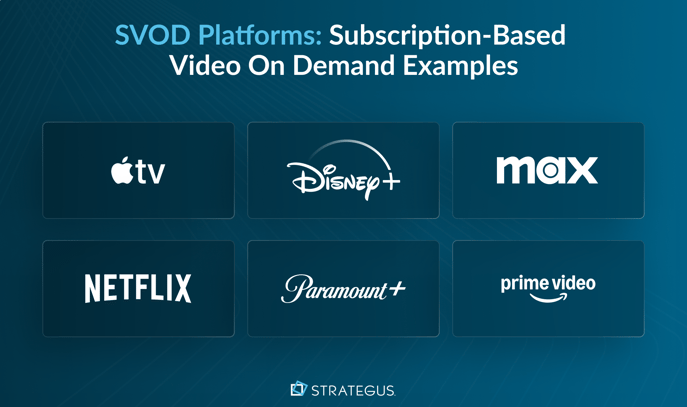
SVOD describes streaming services where users enter a subscription agreement and are charged recurring fees. In return, the user can watch video content without any limits.
SVOD is similar to traditional cable TV packages, allowing subscribers to consume content at a monthly flat rate. With pure-play SVOD, viewers get ad-free content for a premium rate.
Popular SVOD platforms include:
- Apple TV
- Disney+
- HBO's Max
- Netflix
- Paramount+
- Amazon Prime Video
2. Advertising-Based Video on Demand (AVOD)
AVOD services rely on commercials and other advertising techniques to generate revenue. These services are free to consumers. However, viewers must sit through advertisements to access the content.
These services enable viewers to access more on-demand content for a lower overall price when compared to SVOD.
Popular AVOD platforms include:
- Crackle
- Plex
- PlutoTV
- Samsung TV Plus
- Tubi
- Vudu
- YouTube
3. Transactional Video on Demand (TVOD)
With TVOD, users can purchase specific video content on a pay-per-view basis. This model offers viewers a set period of time (usually 24 hours) to watch ad-free premium content or one-time live events.
An easy way to think about TVOD is as a digital Blockbuster. Viewers can either rent or buy each movie or TV show.
Popular TVOD platforms include:
- Amazon Prime Video
- Google Play Movies
- iTunes
- YouTube
4. Hybrid Video on Demand (HVOD)
The latest OTT monetization model, HVOD, employs a mix of the monetization tactics detailed above, often with ad-supported content for a lower price than SVOD.
In addition, HVOD services will include TVOD content, providing customers with multiple ways to enjoy the video content they want at an affordable price.
Popular HVOD platforms include:
- Netflix
- Amazon Prime
- Disney+
- HBO Max
- Paramount+
5. Free Ad-Supported TV (FAST)
For viewers looking to do away with paid subscriptions altogether, FAST apps make it easy. These streaming services deliver linear channels at no cost to viewers, playing everything from reruns, old movies, platform-specific content, and local news.
Many smart TVs (like Roku) have default FAST apps (like the Roku Channel) within the interface, giving viewers a free and easy option for lean-back viewing out of the box.
Here are some popular FAST platforms:
- Pluto TV
- Tubi
- The Roku Channel
- Xumo
6. Virtual Multichannel Video Programming Distributors (vMVPDs)
vMVPD services deliver linear TV channels (with ads) to paying subscribers. Households looking to cut the cord without losing access to premium live sports content and must-watch shows from popular cable networks are the target market for these services.
Popular vMVPD platforms include:
- YouTube TV
- Hulu Live
- Sling TV
- FuboTV
- Philo
- DirecTV Stream
OTT Advertising Costs
OTT advertising is priced on a CPM (cost per thousand impressions) basis.
Typical costs range from $25 to $40 CPM, depending on targeting, platform, and inventory quality, making it more expensive than most digital channels. OTT offers flexible minimums (especially via programmatic buying), precise targeting capabilities, and in-flight creative and targeting optimization.
Factors that influence the actual cost of advertising via OTT include:
- Audience targeting: The more precise the targeting parameters, the higher the CPM. However, wasted impressions decrease, meaning overall efficiency improves.
- Inventory quality and platform: Premium platforms like Netflix and Hulu command higher CPMs than AVOD platforms like Tubi or Pluto TV, reflecting the difference in audience engagement and content environment.
- Ad format: In-video non-skippable ads carry a higher CPM than banner or overlay formats, due to their higher engagement and completion rates.
- Campaign duration and frequency: Longer flights and higher frequency targets increase overall spend but can improve brand recall.
- Programmatic vs direct: Direct deals with publishers typically carry higher CPMs but offer better placement guarantees and first-party data access, while programmatic buying offers more flexibility and scale.
Most managed OTT campaigns have minimum spend thresholds, typically in the range of $5,000 to $15,000 per month, depending on the partner and campaign scope. Strategus works with advertisers to find the right entry point based on goals and budget.
Benefits of Programmatic OTT Advertising
With traditional TV ads, you pay upfront, hoping the right people are watching, but there’s no guarantee.
Programmatic CTV changes that. Ads are bought through automated auctions and shown to specific audiences, not just whoever happens to be watching a show. This makes your ad spend more efficient and helps you reach the right people at the right time.
Here are the main advantages of programmatic advertising:
1. Precise targeting and localization
Programmatic OTT allows advertisers to only reach their desired audience and thereby eliminate wasteful ad impressions served to the wrong viewers. This is done by layering first- and third-party data sources to build custom audiences.
Some of the parameters that can be used to target OTT viewers include:
- Significant life event indicators, such as a recent move, graduation, or family events like welcoming a new baby.
- In-market signs like house renovations, seasonal conditions, and buying interest signals.
- Activities and interests such as being an outdoor enthusiast, avid gardener, or luxury traveler.
- Location-based targeting ranging from geofencing at the zip code level to conquesting foot traffic from competitor stores.
2. Campaign personalization
Precise targeting lays the groundwork for ensuring a more relevant viewing experience with tailored campaigns.
This is because the programmatic nature of CTV helps marketers craft personalized campaigns by adapting ad creatives to individual audience segments.
Let's take an example of an auto dealership. It could segment its audience based on lifestyle components and customize the creative accordingly.
For new mothers requiring a spacious enough vehicle to fit a car seat, a dealership might opt to promote their Toyota Highlanders. Meanwhile, they could run ads for their Corollas to lower-earning individuals who’d been researching sedans.
The result? The right message to the right buyer at the right time.
Learn more about CTV best practices →
3. Ad frequency capping
After irrelevance, one of the biggest complaints from end users watching ad-supported content is the frequency of a given ad. Nobody wants to see the same ad on repeat throughout a single program, which is where frequency capping comes into play.
Frequency capping is the ability to limit the total number of times a viewer is exposed to a particular advertisement.
For this, you’ll want to confirm that your CTV ad partner offers frequency capping and other tactics to prevent ad fatigue.
4. Omnichannel retargeting
Because OTT ads run in digital environments, advertisers can re-engage the same users on other devices through cross-device retargeting.
For instance, a brand might initially reach a viewer on their smart TV, and then follow up with additional touchpoints via online video ads on YouTube, streaming audio ads on Spotify, and social media ads on Instagram.
This type of full-funnel advertising isn’t super common, but it’s a core part of how we approach OTT/CTV advertising at Strategus.
5. Real-time measurement and multi-touch attribution
Advertisers need to see how many people saw an ad, how long they watched it, and what actions they took after watching it. While this level of information isn’t possible when advertising on traditional TV, it is with OTT, especially when brands work with a partner like Strategus.
This type of reporting doesn’t just enable advertisers to better understand campaign performance, it also provides the data required to optimize and refine OTT efforts.
Here are some of the attribution points and KPIs you should demand from your OTT provider:
- Brand Lift: Gain information on how campaign exposure influences awareness, attitudes, and opinions about your company.
- Revenue: Rely on a revenue tracking pixel to understand the revenue from online purchases generated by your campaign.
- Geoperformance: Compare performance across different regions to determine which locations warrant additional investment.
- Return on Ad Spend (ROAS): Compare ROAS across different campaigns to determine which tactics are more successful and optimize accordingly.
- Conversion Rate: Measure the percentage of users who complete a desired action following ad exposure, whether that’s making an online purchase, visiting a brick-and-mortar location, or filling out a form. These actions should be tied directly to attribution capabilities to paint the full picture.
Considerations and Challenges of OTT Advertising
OTT advertising offers significant advantages over traditional TV, but it comes with operational complexity that advertisers should plan for. Here's what to watch out for.
Platform fragmentation
The OTT ecosystem has become highly fragmented, now operating across dozens of platforms, each offering different ad formats, targeting parameters, buying methods, and measurement standards.
Many brands simply don’t have the internal bandwidth or expertise to manage this, which is where a managed service provider with the experience to activate and optimize across platforms can be a valuable partner.
Ad fraud and brand safety
Programmatic OTT platforms have built-in protections, but they still carry fraud risk through bot traffic and fake impressions, which leads to inflated view counts and wasted budgets.
There’s also a brand safety consideration to bear in mind; without proper verification, ads can surface alongside inappropriate content.
Working with verified inventory sources and third-party fraud detection tools, and prioritizing private marketplace deals over open exchange buying are good risk mitigation strategies here.
Frequency management
Without cross-platform frequency caps, the same viewer can be overexposed across multiple streaming apps. This is a common viewer frustration that can erode brand perception over time.
Whenever engaging with an OTT partner, verify that they run unified frequency capping across platforms, not just within a single app or publisher.
Attribution complexity
Connecting OTT ad exposure to downstream actions is harder than other digital channels, particularly when viewers move across devices between exposure and conversion.
To properly understand the total impact of OTT advertising programs, use multi-touch attribution models and view-through attribution with appropriate windows.
Avoid using last-click as an attribution model, as it systematically undervalues streaming touchpoints. An OTT is rarely the final marketing touchpoint before a purchase, but that doesn’t mean it doesn’t influence conversion.
Creative requirements
OTT demands high-quality video creative, which carries higher production costs than other digital formats, and different platforms often have different spec requirements, adding further complexity.
The best solution here is to plan creative production as part of the campaign budget from the outset, and work with a partner who can advise on spec requirements across platforms.
OTT Advertising Case Studies Across Different Industries
Now that we've established the importance of OTT and its various applications, let's talk about some concrete examples of how brands across industries partnered with Strategus to use OTT advertising to reach their target audiences.
1. Automotive OTT advertising
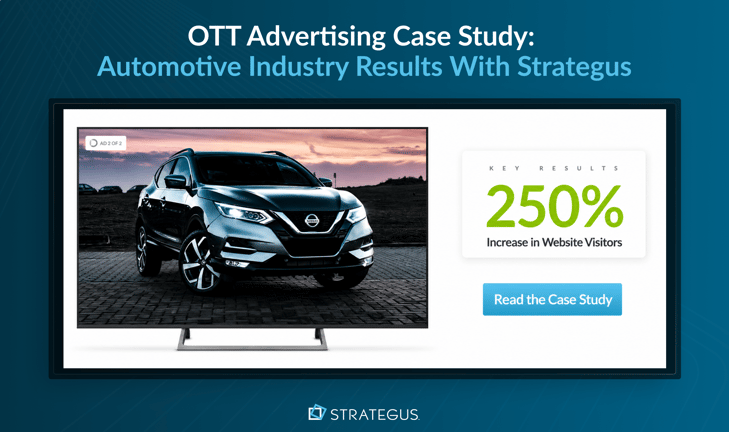
A Southern California Nissan dealership partnered with Strategus to boost showroom visits and sales through Connected TV advertising. The campaign achieved a remarkable 250% increase in website visitors, demonstrating the power of OTT in automotive marketing.
Strategus employed a full-funnel strategy, starting with CTV ads to build upper-funnel brand awareness on large screens, followed by cross-device retargeting using Encore Omnichannel to serve display ads to the same audience on other devices. This comprehensive approach proved that targeted streaming ads can directly influence offline purchasing decisions, helping local dealerships compete effectively against larger advertising budgets.
2. Healthcare OTT advertising
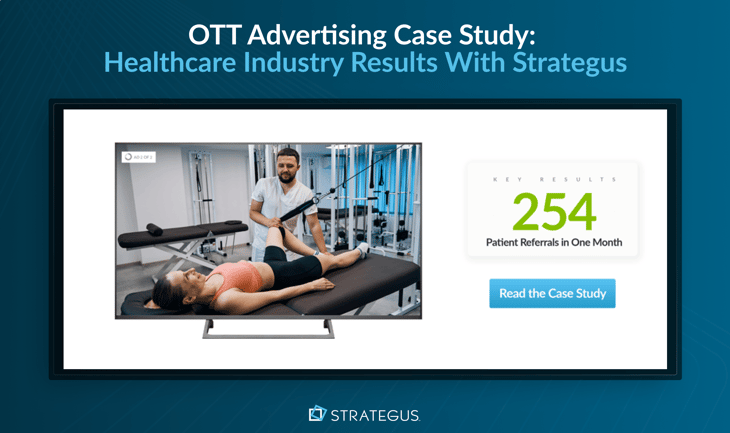
A regional physical rehabilitation center turned to Strategus to overcome traditional marketing limitations and reach potential patients more effectively. The campaign was designed to target physicians and their support staff to drive patients to this particular rehab center, pulling audiences based on occupation to deliver relevant advertising to specialists who make physical therapy referrals.
After two months, Strategus surpassed the client's monthly referral goal, with video completion rates demonstrating accurate audience targeting and ultimately bringing more patient referrals to the client's rehabilitation center. This targeted OTT strategy proved particularly valuable during a historically low period, showcasing how precise healthcare marketing can drive measurable patient acquisition.
3. Law OTT advertising
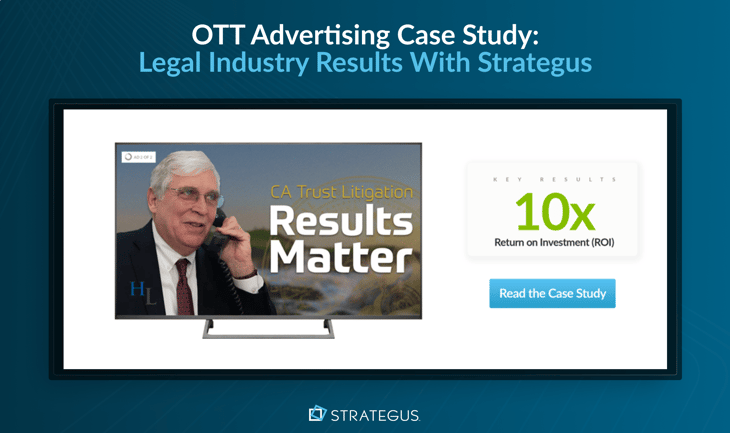
Hackard Law, a trust and estate litigation firm, enlisted Strategus to stand out in the competitive legal market. In the first 8 months of the campaign, Strategus drove 1,978 clicks on Hackard Law's phone number listed on their website, resulting in 3 new confirmed cases for the firm, potentially yielding a 10x return on investment.
By utilizing Strategus' household-level targeting capabilities and strategic frequency capping, the firm efficiently reached potential clients across California. In Mark Hackard's own words: "Strategus is a pioneer in developing and delivering programmatic Connected TV…and Strategus has been a strategic partner for us. We've been successful in our Strategus-led campaigns, and we plan many more."
Advanced OTT Advertising Strategies
The success of the campaigns above wouldn’t be possible with the advanced OTT strategies that Strategus offers.
Smart OTT targeting is an important first step, but the advertisers getting the most out of streaming are also applying more sophisticated techniques: sequencing creative, activating their own data, and measuring attention rather than just completion.
Sequential storytelling/ad sequencing
Rather than serving the same ad on repeat, sequential storytelling delivers different creatives to the same viewer in a defined order, moving them from awareness to consideration to conversion across multiple exposures.
OTT platforms and DSPs now support sequencing tools natively, making it straightforward to structure a narrative arc across streaming services and devices.
A YouTube and Ipsos study found that sequenced campaigns produced a 74% higher lift in ad recall and a 105% higher lift in purchase intent compared with repetitive ad delivery, with longer sequences of three or more ads performing best.
Dynamic creative
Dynamic creative assembles ad variations in real time based on viewer context: location, time of day, audience segment, or content environment.
A single campaign can serve a winter promotion to viewers in colder markets, a summer offer to warmer ones, and a loyalty message to existing customers, all from one content library and without producing entirely separate assets for each segment.
Contextual targeting
Contextual targeting aligns ads with the content being watched at the genre, show, or scene level, rather than relying on individual user identifiers. As third-party data signals erode through privacy regulation and the decline of device IDs, contextual is becoming a more prominent part of the targeting mix.
Combined with available behavioral data, it tends to outperform either method used in isolation, and does so without depending on cross-session user tracking.
Attention metrics
Completion rate has long been the default measure of OTT ad performance, but the industry is moving toward attention as a more useful signal: one that reflects whether a viewer actually engaged with an ad, not just whether it played through.
CTV performs well on this measure. A 2024 study from Yahoo, Omnicom, and Amplified Intelligence found that streaming TV ads captured approximately 9.7 active attention seconds, around 8 times that of mobile and 16 times that of desktop.
Metrics like active attention time and attention rate connect ad exposure to outcomes more reliably than completion rate alone.
First-party data activation and privacy-first targeting
With third-party identifiers declining, advertisers who have built and can activate their own first-party data have a meaningful advantage in OTT.
Matching CRM records against streaming audiences allows brands to reach actual customers and high-probability prospects at the household level, rather than relying on broad demographic proxies.
Launch Smarter OTT Campaigns With Strategus
At Strategus, we don’t just place your ads. We build full-funnel strategies that deliver results. From big-screen exposure to cross-device retargeting, we bring everything under one roof.
Here’s what you get with Strategus:
- Advanced audience targeting based on behavior, location, and intent
- Non-skippable premium inventory across top CTV platforms
- Cross-device retargeting to keep your brand top of mind
- Real-time attribution dashboards to track ROI 24/7
- Expert-managed service so you never have to go it alone
Looking to do OTT advertising the right way? Speak to a Strategus expert to learn more today.
OTT Advertising FAQs
1. What does OTT in advertising mean?
OTT stands for over-the-top, and it refers to the delivery of video advertising across streaming platforms like HBO Max or Disney+.
The phrase “over-the-top” distinguishes this advertising format from delivery through traditional cable TV.
2. What is the difference between OTT and CTV ads?
While connected TV (CTV) refers to the smart TVs used to stream content, over the top (OTT) refers to the way that content is delivered over the internet. These terms are often used interchangeably, but the main distinction comes down to how this content is consumed.
With CTV advertising, marketers gain access to premium ad spaces on the big-screen TV. OTT, on the other hand, refers to all multimedia content streamed to every device, including TikTok videos viewed on smartphones, YouTube clips on laptops, and more.
3. How does OTT advertising work?
OTT advertising often uses programmatic media buying to automate ad placements. This allows marketers to pinpoint their ideal buyers rather than taking the spray-and-pray approach of traditional TV advertising by targeting individual viewers based on their interests, browsing activity, lifestyle choices, and more.
4. Is Netflix a VOD or OTT?
VOD and OTT are not alternatives.
VOD (video on demand) refers to a method of content viewing. VOD viewers can choose what content they want to watch and when (compared to traditional linear TV, which has fixed viewing schedules).
OTT (over-the-top) refers to how the content is delivered, in this case, over the internet rather than via cable TV.
So, Netflix is both VOD and OTT. It's VOD because viewers choose the content they want to watch and when, and it's OTT because the content is streamed over the internet.


Strategus is a managed services connected TV(CTV) advertising agency with over 60,000+ campaigns delivered. Find out how our experts can extend your team and drive the result that matter most.
What to read next